From Benchmarking to Action: Turning Data into Strategic Health Plan Decisions
Health insurers exceeded financial expectations in the first half of 2026. That’s the good news. The downside is that stubbornly high medical costs, sicker risk pools, member abrasion, and policy changes will create significant challenges well into 2027.
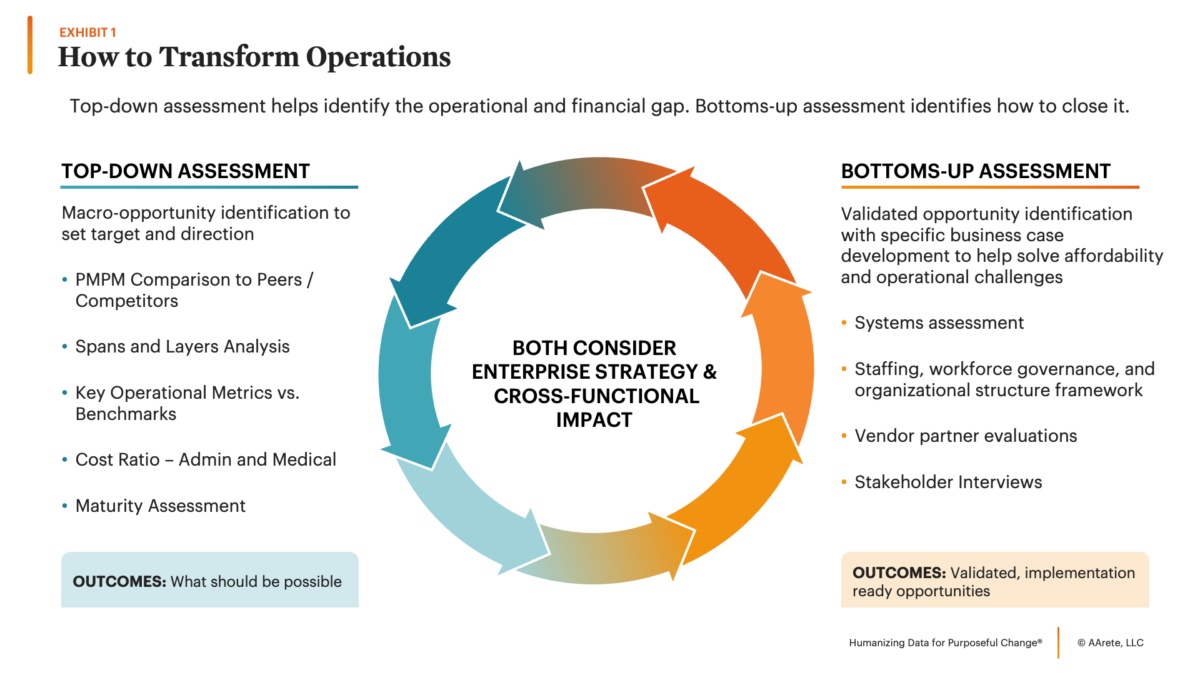
As payer organizations seek to balance cost control and member satisfaction, most boardroom discussions will again focus on per-member-per-month (PMPM) benchmarks. Yet while benchmarks allow plans to compare administrative costs against their peers, they’re single data points that show where to look, not which next steps to take. Individual PMPM benchmarks can even be misleading.
Payers looking to get ahead of their peers should view benchmarks in their proper context, alongside crucial considerations such as plan strategy, market intelligence, and regulatory needs. We have found that deploying this unique strategy can help payers save an average of $20.9 million, which equates to a 14.6% reduction across in-scope spend.
Benchmarks Can Tell the Wrong Story
When plans make strategic decisions based on PMPM benchmarks alone, they often make cuts in the wrong areas. A high PMPM can reflect a worthwhile investment rather than out-of-control spending, while a low benchmark might indicate a lack of digital maturity. To see why, consider the added context behind these three standalone benchmarks.
Above-average administrative costs for medical management. If paired with a strong medical loss ratio (MLR), cutting administrative spend solely to hit the peer median might increase MLR, costing the plan more than it would save.
Median PMPM benchmark for customer service. If this benchmark is paired with below-average call volume, the plan is inefficient and may benefit from additional staffing or new strategic initiatives to reduce call complexity.
Below-median IT spend. If the plan’s operations spend is above benchmark, it might be relying too much on manual work and aging IT infrastructure. The best path forward could be increasing IT costs to accelerate digital transformation, which would reduce operational expenses long-term by eliminating maintenance complexity and eliminating time-consuming tasks.
Each of these scenarios shows that using benchmarks to compare plan performance is just part of the story. Leaders must dig deeper to understand what’s driving the result and whether the current PMPM spend supports larger strategic goals.
Step-by-Step Guide to Move from Comparison to Execution
Assessing a plan’s administrative costs against peers and competitors is essential, but it’s just one part of the process. Moving from a PMPM benchmark to a strategic decision requires a disciplined approach that balances medical cost performance, member experience, and growth opportunities. To accomplish this shift, follow these steps.
Step 1: Examine the drivers behind benchmark variances and connect them to performance. Then test each opportunity against strategic priorities, including key lines of business and market conditions.
Step 2: Set the appropriate maturity target for each functional area based on its worth to the business. Avoid the temptation to seek the highest maturity level possible across the board. Pushing a low-stakes back-office process, such as print and mailroom services, toward best-in-class sophistication can cost more than it will ever return. Under-investing in high-stakes areas like medical management or Star Ratings, meanwhile, can be costlier than it looks on a benchmark chart. The right target is different for each function, and it changes over time.
Step 3: Prioritize opportunities by value, organizational readiness, capacity, and dependencies. Pursue near-term efficiencies to free up capital for longer-term priorities.
Building an execution roadmap with clear ownership, milestones, decision points, and expected value will help plans drive the process, measure savings incrementally, revisit opportunities, and release capacity toward other strategic goals rather than treating cost reduction as an endpoint.
Make Better Decisions. Not Better Comparisons.
Taking a holistic view of PMPM benchmarks requires aligning cost savings opportunities with the organization’s maturity level, cost pressures, and market differentiators.
Putting these pieces together helps the plan succeed. Historically, these are difficult decisions to navigate along the benchmarking journey. A partner may provide an outside, unbiased view of operations to help uncover levers and build an implementation roadmap.
PMPM benchmarking will continue to dominate boardroom conversations as cost pressures persist into 2027 and beyond. But benchmarking only starts the conversation. Disciplined action creates value. The organizations that make the right bets will move quickly from comparison to context, choice, and execution.
Learn more about AArete’s Healthcare Payer Consulting Solutions.