Closing the Financial Gap: Extracting Untapped Value From Your Vendor Ecosystem
Vendors are Embedded into the Payer Ecosystem
The modern health plan is no longer a self-contained enterprise. Increasingly, it operates as an orchestrator of an ecosystem of hundreds of vendors that perform critical functions across the health plan. When a member calls the service line, checks a benefit, or receives an ID card; when a provider verifies eligibility or submits a claim; or when a prior authorization is adjudicated, a payment integrity edit is applied, or care management outreach is triggered, a vendor is often directly involved in delivering the service. These relationships extend across nearly every function of the health plan and increasingly shape its cost, performance, and member and provider experience.
As a result, a substantial share of a health plan’s administrative cost base, and increasingly its medical cost performance, is influenced by the contracts it signs and how effectively those partners are managed. The vendor relationship is not a procurement footnote. It has become the operating model itself.
Against today’s economic and political pressures, reducing administrative cost and rethinking vendor relationships has become a critical priority. Renegotiating rates and managing annual increases is no longer enough. Plans need to reconsider what they buy, how much they consume, which partners perform the work, how those partners are compensated, and whether the underlying operating model still makes sense.
Why the vendor landscape is where the gap closes
Every payer CFO is carrying a number this year, a gap that can exceed $100M. The instinct under pressure is to reach for the levers closest at hand: hiring freezes, discretionary cuts, and layoffs. Those levers are fast, but rarely durable, and the cost ultimately returns.
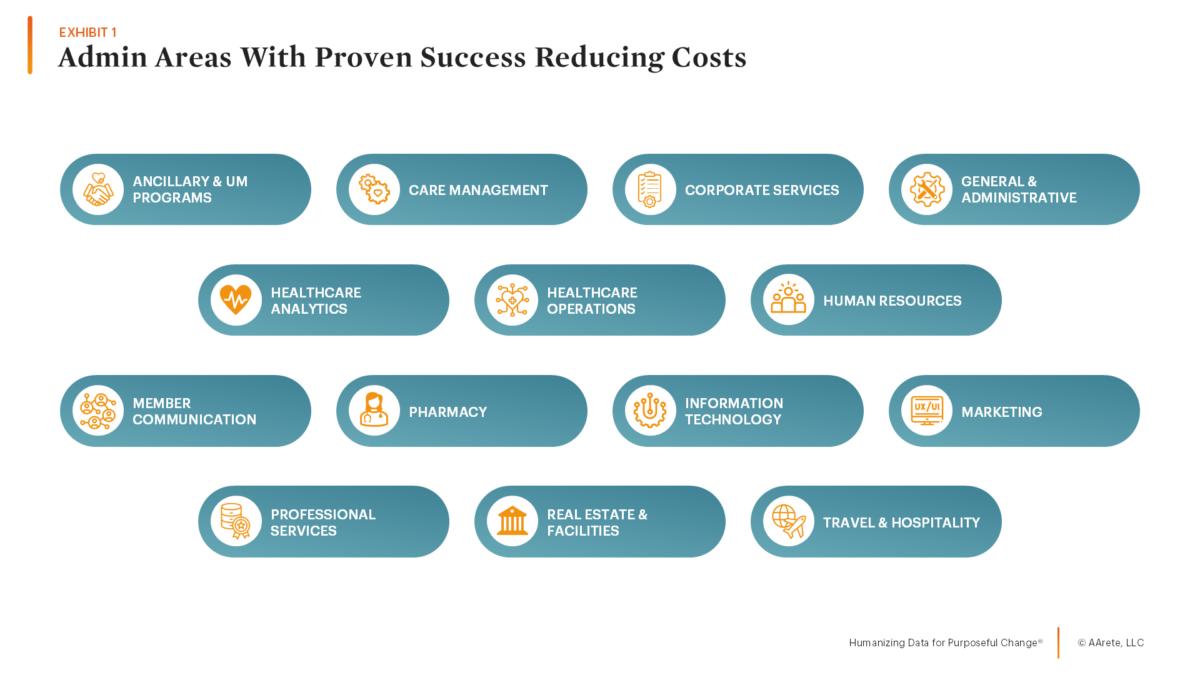
The vendor landscape is different. It is large, it is concentrated, which means it is measurable, benchmarkable, and addressable without degrading the member experience or the organizational mission; to the contrary, it can be leveraged to improve them. Unlike a workforce reduction, restructuring a vendor relationship can preserve service levels, workflows, and user experience while removing real dollars from the run rate. It is a high-yield pool of value most plans have not fully harvested. Most plans are missing out on nearly 9% to 23% of potential real dollar savings within their vendor landscape. The targeted categories below are how you harvest that value from your vendor partners.
Savings Strategies: Start with the relationship, not the invoice
The mistake most cost out programs make is starting with price. Real value starts with a holistic, end-to-end understanding of what each relationship is and the value it is bringing to the organization.
- Is this a delegated or at-risk program that should be delivering a demonstrable return on investment? Are those results being realized and tracked effectively?
- Is it a transactional service supporting member communications, where unit cost feels easy, but volume is the actual source of value creation?
- Is it an enabling technology whose license count has drifted years past actual usage?
The right strategy is different in each case, and applying a rate lever to an ROI problem or a utilization problem leaves most of the value on the table. Once the relationship is understood, we have developed six strategies that we believe will help your plan close the gap:
1. Rates
Despite being a lower opportunity strategy, market competitive pricing remains the fastest source of savings. Armed with credible benchmarks and a data-driven view of what peer plans pay, incumbents can be renegotiated to market while preserving the relationship, the workflow, and the service level.
2. Utilization & Demand Management
Price is only half the equation; volumes deliver the most meaningful impact. Licenses provisioned but unused, tiers over purchased, transactions that shouldn’t occur, vendors in the stack that are obsolete all inflate spend. Right sizing utilization, licensing, and maintenance frequently rivals rate negotiation in impact in terms of ease and % returns.
3. ROI & Performance Accountability
For delegated, at-risk, and performance-based programs such as payment integrity, care and utilization management, population health, the question is not just what does it cost, but what value it delivers-and can we prove it. Many plans cannot cleanly answer that. Establishing these programs with PMPM and ROI tracking exposes underperformers, strengthens the plan’s negotiating position, and often reveals that a vendor costs more than the value it creates.
4. Vendor Consolidation
Sprawl is expensive. Overlapping tools, redundant point solutions, and multiple vendors serving one function fragment volume and forfeit leverage. Consolidating to fewer, deeper relationships concentrates spend, unlocks tiered pricing/economies of scale, and reduces the hidden cost of managing your contracts.
5. Insourcing & Outsourcing
Every function should periodically revisit its make-versus-buy decision, as scale, technology, and labor economics change. Some outsourced work may grow large enough to bring in-house at lower cost and greater control. Conversely, some internally staffed functions may now be cheaper and better delivered as a service, vendors may offer new capabilities that cannot be replicated in-house (e.g., offshore operations/labor arbitrage, Ai enablement, etc.).
6. Operating Model & Strategy
The largest prizes come from changing how the work is done, not just what it costs. Automating a manual process, redesigning a workflow, or restructuring a program can collapse both vendor and internal cost simultaneously with those savings compounding and lasting.
7. Commercial Terms & Protections
Though these may not impact this year’s administrative cost reduction target, they will impact next year’s and your future self will thank you. The right contractual terms preserve flexibility and leverage to capture savings throughout the life of the relationship. Termination-for-convenience rights limited minimum commitments (revenue, etc.), and strong transition and knowledge-transfer obligations allow plans to resize or exit relationships when costs become uncompetitive, performance deteriorates, or business needs change. Meaningful fees at risk against SLAs and KPIs hold vendors accountable for performance, while productivity commitments ensure the plan shares in future savings created through AI, automation, and innovation. This concept is critical to preserving plan performance and oftentimes is forgotten or sacrificed by plan leadership in pursuit of short-term goals.
The Operations Intersection with Vendors
You cannot investigate your vendors seriously without exploring transformative options for your operations. The two are inseparable. A payment integrity vendor’s ROI is bounded by the quality of the claims process feeding it. A call center partner’s cost is a function of call volume the plan itself generates through avoidable member confusion. A UM vendor’s value depends on the clinical policies and staffing model wrapped around it.
Pull the vendor thread and the operating model may unravel. Outcomes range from where internal teams and external partners duplicate, where handoffs create rework, where a process redesign would take cost out of both sides of the ledger at once, or where internal capabilities may trump the value created from a third-party partner. A rigorous vendor review should be an operating model review conducted through the most measurable lens available.
Target Number One
Whatever gap you are carrying, $50M, $100M, or more, the vendor ecosystem is where a meaningful share of it can be closed, faster and more durably than almost any other lever available to you. The spend is large, and the strategies can be transformative. Closing the gap here does not mean cutting the mission or degrading the member experience. It means paying market rates, using only what you need, holding delegated programs to a real ROI, and rethinking the operations underneath.
The value is already in your contract. The only question is whether you extract it before your competitors extract theirs. Make the vendor ecosystem target number one.