The Health Plan Blueprint for Network Optimization
How to build, sculpt, and manage lower cost, higher quality provider networks.

Provider payments are the single largest cost driver for health plans, yet many payers are still leaving 2–6% of that spend on the table due to underperforming provider networks. At the same time, margins are at their lowest they’ve been in two decades, increasing pressure to improve network performance.
When optimized, competition among provider networks can reduce cost of care, improve quality, expand access, and attract new members. However, many organizations struggle to fully realize these benefits.
Several structural challenges are driving this underperformance:
- Fragmented data and manual processes create operational bottlenecks
- Misaligned incentives weaken alignment between providers and health plans
- Provider consolidation is eroding payers’ leverage in contract negotiations
- Soaring administrative costs and declining member satisfaction erode competitive advantage
National health plans are overcoming these challenges with aggressive moves. They’re implementing rate cuts, terminating provider contracts, and steering members toward higher-quality, lower-cost providers.
Those bold initiatives, however, can cause frustration and confusion, resulting in swift member backlash and negative headlines.
There is a better approach, one that’s less aggressive and more measured.

In this playbook, we’ll explore the strategies and tradeoffs plan leaders should consider when optimizing their networks.
Let’s focus on:
1 THE THREE LEVERS THAT DRIVE NETWORK PERFORMANCE
2 SHIFTING FROM FEE-FOR-SERVICE TO VALUE-BASED CONTRACTING
3 STEP-BY-STEP NETWORK OPTIMIZATION GUIDANCE
4 BUILDING STRONGER PROVIDER RELATIONSHIPS
The Three Levers That Drive Network Performance
Underperforming plans treat network optimization as one-time, isolated actions. High-performing plans integrate network design and contracting into a continuous approach deliberately designed for the unique economics and member needs of each line of business. Here’s where plans most often go wrong and how to fix it.
NETWORK STRATEGY AND DEVELOPMENT:
Plans that skip this step end up optimizing for the wrong outcomes. Strategy work means defining clear goals, whether it’s entering a new market, correcting underperformance, or redesigning a mature network to meet new quality and cost targets. Plans must then identify anchor partners and build intentional segment-level approaches that account for cost, quality, and site of care. Without such a measured approach, sculpting and contracting efforts lack direction.
NETWORK SCULPTING AND REDIRECTION:
A wellcontracted network that routes volume to the wrong providers still fails. Sculpting is the ongoing discipline of deciding which providers belong, in what role, and at what volume. It also involves assessing providers across cost, quality, and geography, and making difficult decisions about provider intervention strategies using a spectrum of aggressiveness to move more volume toward high-quality, low-cost providers.
FEE-FOR-SERVICE (FFS) AND VALUE-BASED CARE (VBC) CONTRACTING:
Contract structure either reinforces or undermines network design. A plan that steers members toward a lower-cost ambulatory surgery center but charges the same cost-share as a hospital outpatient department (which costs 2-3 times as much) wastes the network’s potential. Knowing when to deploy FFS versus VBC, and aligning both with benefit design, is what turns a well-designed network into a financially sustainable one. Intentionality connects all three. When strategy, sculpting, contracting, and benefit design work in concert, network optimization stops being a cost-control exercise and becomes a genuine competitive advantage.

Managing Director
“The definition of marketable network is different for plans with higher name recognition than smaller plans. Commercial/ACA plans may need a broader network to appeal to more members, but they need to make strategic decisions, because the wider the network, the higher the costs.”
One Strategy Doesn’t Fit All
1. MEDICARE ADVANTAGE
Optimize networks around quality performance, Star Ratings, and risk adjustment capture, ensuring PCP alignment drives coding accuracy and gap closure. Highperforming networks require tight integration between clinical programs, provider incentives, and referral pathways to maximize outcomes and reimbursement. Under investing in primary care attribution and specialist referral control limits Star performance and RAF capture, even with a strong provider network.
2. MEDICAID
Focus on network adequacy, geographic access, and provider stability, ensuring compliance while managing high variability in member needs and social determinants. Unit cost and utilization controls are strong levers. Subpopulations require fundamentally different provider strategies, and redetermination cycles can shift the population mix faster than network design can respond if you’re not continuously optimizing.
3. COMMERCIAL
Drive unit cost efficiency and targeted value-based adoption while tailoring networks to employer segments and benefit strategies. Optimization often requires tiered and narrow network designs paired with steerage mechanisms to shift volume. Align network design with product strategy to avoid misaligned incentives and weaker employer value propositions.
4. ACA/MARKETPLACE
Prioritize cost efficiency and competitive pricing while maintaining a network broad enough to attract and retain members in a highly price-sensitive market. Leading plans balance narrow network economics with targeted access to high-demand providers to remain marketable. Adequacy alone doesn’t win in ACA. Marketable networks require a deliberate strategy across the provider ecosystem to drive enrollment and retention.

Shifting From Fee-For-Service To Value-Based Contracting
Leading payers are shifting high-impact spend into value-based models while using fee-for-service arrangements to maintain flexibility and rate discipline.
FFS CONTRACTING
FFS remains the foundation of most Commercial and Medicaid contracts, and continues to play a role in Medicare Advantage. When done effectively, it’s a rate discipline tool. Plans should continuously evaluate provider-level reimbursement against market benchmarks to identify outliers, quantify savings opportunities, and build negotiating leverage before entering contract discussions.
Contract structure matters as much as rates. Reimbursement methodologies, carveouts, escalators, and stop-loss provisions can obscure the true cost of provider relationships. Plans that understand these nuances find leverage others miss and enter negotiations with a stronger, more defensible position.
VBC CONTRACTING
VBC creates its greatest value when deployed selectively, not as a broad shift away from FFS, but as a targeted strategy applied where utilization, quality, and episode cost can be meaningfully measured and influenced. Plans seeing the strongest results are sequencing the transition deliberately, building their infrastructure continuously rather than in one giant leap.
Provider readiness is the determining factor. High performers with strong data capabilities and a track record of managing utilization are the strongest candidates for meaningful risk. Less mature providers may be better served through FFS contracts until they can succeed in a risk-bearing arrangement. For providers needed for adequacy but who are not yet high performers, upside-only VBC can serve as a structured improvement pathway, creating accountability without requiring suppression or termination. Many VBC arrangements remain upside-only, limiting their impact on total cost of care and quality. Moving toward more meaningful risk should be phased and targeted, with downside risk introduced only where providers have the analytics, care management capabilities, and financial readiness to manage performance effectively.

WHAT PLANS SHOULD DO NOW
- Start with primary care as the anchor.
- Use PCP attribution and panel alignment to create accountability and unlock downstream impact.
- Expand into high-cost measurable episodes. Oncology, maternity, MSK, and post-acute are the next logical extensions.
- Phase in downside risk selectively, only where providers have the infrastructure, data, and scale to perform.
- Integrate VBC with network design.
- Prioritize high-performing VBC providers in steering, tiering, and benefit design decisions.
BY SHIFTING MORE CONTRACTS TOWARD VBC, PLANS CAN GAIN
- 2%–4% total cost reduction over 3–5 years when deployed selectively in high-impact populations and service lines.
- Sustained improvement in quality and risk capture through tighter PCP alignment and care management integration.
- Greater control over utilization and referral patterns when incentives, attribution, and reporting are aligned.

Managing Director
“Getting the revenue right in value-based contracts has a huge impact on profitability. From a contracting perspective, VBC can help plans get there quicker, but they have to have the right support for providers to meet their needs and goals.”
CONTRACTING IMPLICATION BY LINE OF BUSINESS
MEDICARE ADVANTAGE: CMS has a stated goal for 100% of traditional Medicare beneficiaries and a majority of Medicaid beneficiaries to be covered by a risk-sharing arrangement by 2030. MA plans are following CMS’ lead and accelerating VBC contracting activities. Going forward, plans that work to improve their Star Ratings through innovative contracting strategies with PCPs will achieve the greatest success.
MEDICAID: VBC in Medicaid is still growing but remains a small percentage of spend. Plans implementing value-based contracts are moving from limited, program-specific models toward more measurable, state-driven arrangements focused on cost, quality, and outcomes. Successful strategies prioritize durable provider partnerships and phased pathways to VBC rather than rapid disruption. The payers with the biggest advantage will be those with strong local provider ties, real care management and data capabilities, and enough scale in a market to make value-based arrangements work.
COMMERCIAL AND ACA/MARKETPLACE: These lines have significant member cost-sharing components. Consequently, steering members toward high-quality, low-cost providers through VBC has a direct financial impact on members, making quality and cost efficiency critical selling points.

A Practical Roadmap to Network Optimization
Network optimization requires ongoing assessment to stay ahead of market shifts, provider changes, and evolving member needs. At AArete, we recommend health plans conduct a formal review annually, with targeted assessments triggered by key events such as contract renewals, market expansions, Star Rating changes, or shifts in utilization patterns. Here’s a seven-step roadmap to guide that journey.
1. DEFINE NETWORK GOALS
Network goal setting is one of the most frequently skipped steps in network optimization. It’s also one of the most important. Plans entering new markets need to consider how they will differentiate themselves. Payers managing an existing network need to identify clear targets, whether it’s improving marketability to boost enrollment or fixing utilization problems by driving members to lower-cost sites of care.
Once goals are clear, plans can begin to identify gaps and growth opportunities. Then they can determine the anchor partners around whom the network will be built. Plans should create intentional strategies for each provider segment, accounting for cost, quality, and site of care, then laddering up to how each segment will contribute to overall network goals.
2. ANALYZE AND BENCHMARK
To build a solid business case for their network, plans should dive into the data. Start by evaluating contracts and claims data from all providers. Analyze reimbursement structures, referral patterns, and quality definitions by provider type. AI and machine learning can make this easier, enabling plans to evaluate hundreds of variables quickly and surface insights missed by conventional scorecards.
Then leverage market intelligence to benchmark providers’ quality and cost data against competitors. Look into how competing plans are reimbursing their providers and their volume expectations. Plans should use these findings to determine their leverage when pursuing market-rate alignment or enhanced and market-leading terms during contract negotiations.
3. SCULPT THE NETWORK
Network sculpting involves ranking providers based on cost and quality, then taking actions to improve utilization of high-performing providers and mitigate the deficits of low-performing ones. Start by performing a four-quadrant analysis of providers utilizing this prioritization matrix.
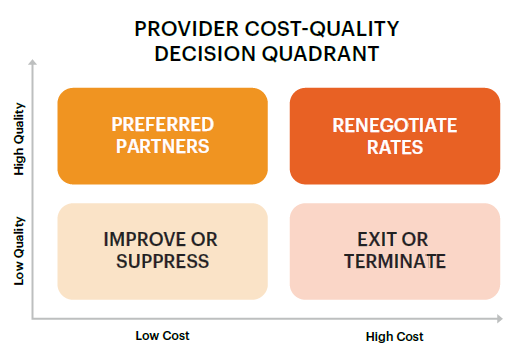
Use the results to determine which interventions might be necessary. Make high-quality, low-cost providers anchor partners. Focus on unit cost reduction and contract restructuring for high-quality, high-cost providers. Consider setting performance targets or limiting volume for low-quality, low-cost providers. Terminate or suppress low-quality, high-cost providers. Once interventions are complete, repeat this exercise with other provider groups to find additional improvement opportunities.
4. OPTIMIZE VBC PROGRAMS
Assess the status of existing VBC agreements to find out what’s working and what’s not. Determine whether VBC contracts are generic or customized. Then evaluate the incentives in those contracts to decide whether they can move the plan toward a path of shared risk with providers.
Success with VBC also depends on having the proper infrastructure, including detailed reporting and analytics to track performance and value. Consider establishing a formal governance structure, such as a Joint Operating Committee, where members from provider and payer organizations can review data together and align on performance.
5. MONITOR PROVIDER PERFORMANCE
Set key performance indicators (KPIs) for quality, cost, and operational efficiency, then use provider scorecards to track progress. Over time, expand scorecards to include operational activities, such as appeals and grievances. Doing so can give plans insight into the cost to work with each provider.
Equally important is monitoring provider data, especially for MA plans. Starting in CY 2027, MA organizations must submit directory data for publication in the Medicare Plan Finder, update it within 30 days of any changes, and attest annually to its accuracy. Payers across all lines of business should work closely with providers to ensure directory information is updated regularly so members can access care without unnecessary delays.
6. STEER MEMBERS TO HIGH-PERFORMING PROVIDERS
Network steerage techniques drive members to high-quality, low-cost providers and lower-cost sites of care. These strategies could include directing colonoscopy patients toward provider offices and away from hospital outpatient departments, which can charge up to 2–3 times the price with no significant risk or quality differences.
In lines of business with cost-share components (Commercial, Marketplace/ACA, and some Medicare Advantage plans), enabling access to high-quality, low-cost providers will benefit members and help plans reduce costs. Medicaid plans do not have a cost share component. They should focus their network steerage efforts on expanding quality and access.

Managing Director
“Provider education is a key intervention strategy. Plans should engage poor-performing providers in conversation and map out the steps they can take to become stronger network partners.”
7. COMBINE NETWORKS WITH PRODUCT AND BENEFIT DESIGNS
Network optimization decisions must be made in parallel with product and benefit design. Doing one without the other can put members in an untenable position. To see why, consider a plan that contracts with the only orthopedic surgeon in a rural county to satisfy network adequacy requirements. If that surgeon is affiliated with an out-of-network health system, it could also lead to confusion and higher costs for members. To avoid these situations, plans should understand how each provider connects to the broader care network and weigh the potential implications.
PENDING TELEHEALTH CHANGES COULD IMPACT RURAL AREAS
Rural areas, where provider supply is scarce, pose challenges to network steerage strategies. Adding to the complexity is the looming end to home based nonbehavioral telehealth access, set to expire on Dec. 31, 2027. Should it expire, the rule will revert back to the pre pandemic standard requiring Medicare beneficiaries to access telehealth in a qualifying medical facility. This rule would fundamentally hurt members in rural areas who live farther away from such facilities.

Building Better Relationships:
TURNING PROVIDERS INTO PARTNERS
Contract negotiations and reimbursement changes can create friction between payers and providers. That’s why plans implementing network optimization strategies should seek deeper partnerships with their anchor partners. There are two ways to do so:
HELP PROVIDERS ACHIEVE OPERATIONAL EFFICIENCIES
Top concerns for providers include finding revenue opportunities, attaining quality bonuses, and spending less time on paperwork so they can spend more time with their patients. A payer organization can show it’s a good partner by working with high-quality, low cost providers to simplify time-intensive processes such as prior authorizations or claims denials.
One practice is gold carding, where a health plan exempts high-performing providers from prior authorization requirements for certain services. At least 10 states have enacted gold card laws, and others are considering doing so. Effective gold card strategies require strong monitoring to prevent over-utilization once status is granted.
Medicaid payers are employing other creative strategies to build partnerships, including funding part-time resources within provider groups to help eligible patients access social services from community-based organizations. This type of partnership helps members remain healthier while offsetting providers’ administrative complexities related to Social Determinants of Health.
COMMUNICATE CLEARLY ON NETWORK GOALS & PROVIDER ROLES
Plans developing new networks should clearly communicate their goals and explain why their network is different from other health plans. Doing so can help plans ensure their networks are adequate and properly affiliated while allowing providers to envision potential referral patterns and creating better network performance for everyone.

Managing Director
“When deployed intentionally, value-based contracts become a source of competitive advantage, allowing plans to preferentially grow high-performing providers, steer volume with confidence, and bend unit cost trends without blunt rate cuts.”
Network Optimization in Action
LONG-TERM CARE SAVINGS WITH A VALUE-BASED PROGRAM
AArete targeted addressable spend with a VBC program to improve LTC quality and reduce hospital utilization.
Overview

AArete partnered with a large West Coast managed care organization to reduce long-term care (LTC) utilization and total cost of care while improving quality of care for its Medicaid and Duals LTC population.
AArete was tasked with developing a VBC program incentive low-performing facilities to improve quality, with the potential to expand all facilities.
OUR APPROACH

Analyzed public and our proprietary claims datasets to identify opportunities to improve quality and reduce costly downstream utilization in SNFs.
Developed program targets, measures, and shared savings policies, with built-in facility incentives.
Amended contracts for 75 facilities under a multi-year, value-based shared savings program.
Established processes for tracking program, processing payments, and updating program year-over-year.
RESULTS

Created a new VBC program to yield long-term quality improvements and optimize LTC utilization.
Developed automated performance and financial dashboards to support negotiations and track program progress.
Projected reductions in total cost of care by 1-3% (hospital spend by 3-10%) with estimated 5-year gross savings or $8.8M.
Supported leadership by using client and industry data to model gainsharing amounts and payout tiers for each facility.
Achieve Network Optimization with a Trusted Partner
Network optimization involves multiple moving parts, and each one can have a positive or negative effect on a health plan. Working with a proven partner can help payers avoid the pitfalls and create adequate, marketable networks that improve quality and reduce costs.
AArete combines its deep industry expertise and proven track record to help payers create networks that achieve organizational goals. Our health plan consultants guide payers through a structured, data-driven journey that uncovers inefficiencies, redefines contract performance, and sustains results through actionable insights. Built on a foundation of data, analytics, and technology, the AArete Network Optimization Engine helps plans:
- EVALUATE AND DIAGNOSE: Uncover what’s driving cost, inefficiency, or underperformance
- DESIGN AND OPTIMIZE: Build tailored solutions that align incentives and improve outcomes
- ACTIVATE AND OPERATIONALIZE: Launch with confidence, backed by people, processes, and technology
- MEASURE AND EVOLVE: Transform insights into continuous improvement and growth