The Procurement Leader’s Playbook: AI, from Assessment to Action

Procurement is one of the most data and workflow-intensive functions in any organization, managing thousands of relationships, millions of transactions, and enormous volumes of contracts and spend. Yet outdated tools and disconnected technologies often prevent it from operating at its full potential. With an ever-growing list of tools and no shortage of competing priorities, knowing where to start isn’t straightforward.
AI has created real opportunities to drive productivity and efficiency while also strengthening supplier and stakeholder relationships and sharpening how organizations manage third-party spend. How organizations implement AI will determine whether the technology drives efficiencies or creates more frustration.
Understanding the AI Spectrum:
PREDICTIVE, GENERATIVE, AND AGENTIC
Before procurement organizations can determine what’s possible with AI, they need to understand their options. The AI landscape has advanced rapidly within the past few years, and three evolutionary stages of AI are now emerging. The first wave of procurement technology brought process automation. These tools reduced manual steps but did not fundamentally change what was possible. The second wave, now underway, moves beyond automation to intelligence: systems that can read, reason, analyze, and act.
1. PREDICTIVE AI:
Predictive models use historical data to identify future trends. Examples include forecasting commodity price movements to inform sourcing timing, predicting supplier financial distress before disruption occurs, flagging invoices likely to result in a payment exception, anticipating demand spikes by category to support inventory planning, and scoring new suppliers on risk based on patterns from the existing supplier portfolio.
2. GENERATIVE AI:
A step up from predictive AI, generative AI solutions use Large Language Models (LLMs) to synthesize complex data into new content. Chatbots, contract intelligence tools, and search applications are common examples. In procurement, this includes drafting RFP requirements and supplier questionnaires from a category brief, extracting and summarizing key obligations from a portfolio of contracts, answering employee procurement policy questions in natural language, generating supplier performance summaries from structured scorecard data, and producing negotiation briefings that synthesize spend history, market benchmarks, and supplier risk signals into a document.
3. AGENTIC AI:
Agentic AI uses agents to automate multi-step processes, a promising solution to improve efficiency. To implement, identify high-friction work, validate the opportunity, and prove value with a focused pilot that demonstrates measurable, touchless execution before expanding scope. Then, scale across systems as a horizontal capability, an operational model shift you deliver through a sequence of pragmatic projects, rather than a one- time platform upgrade. An AI procurement agent is a system that perceives its environment, reasons about the appropriate next action, and executes tasks without requiring a human to initiate every step. Examples include invoice exception handling, supplier onboarding orchestration, contract renewal management, and tail spend capture.

HONSET ASSESSMENT:
ARE You Ready?
Procurement leaders must ask themselves if they are ready for AI. The framework for readiness exists across four critical dimensions: data quality, process maturity, technology architecture, and organizational capability. The challenge organizations have been having is saying yes to AI before having the right data, process, or architecture to make it effective. AI should be amplifying the leading practices you are deploying, not being used to plug a hole. To start, here are the four areas of AI Readiness:
1. DATA QUALITY
Data is the lifeblood of AI. Poor data and AI adoption happen every day. Bad data doesn’t mean you have to say no to an AI project; it just means you need to plan better. The first step is being honest with critical dimensions of your data:
- SPEND DATA: Is spend categorized with >80% accuracy? Are all source systems feeding a unified spend cube?
- CONTRACT DATA: What percentage of contracts are in a digital repository? Are key data fields structured and extractable?
- SUPPLIER MASTER: Is there a consistent record for suppliers across systems?
- ITEM/CATALOG DATA: Are goods and services described with sufficient
specificity to enable substitution, consolidation, and benchmarking?
TOOL HIGHLIGHT
AArete has developed a powerful solution that turns unstructured data into actionable insights. Doczy.ai™ digitizes and interprets vendor contracts and invoices creating a structured information repository, leveraging proprietary AI technologies and decades of contract experience to deliver 99%+ accuracy. The metadata can be enriched with market data, spend data, invoice data, and contract clause libraries to solve discreet problems for procurement, sourcing, and contracting.
Doczy.ai™ is a tool that will enable you to leverage the power of AI with imperfect data. Even if you have poor data quality, you can identify the two or three use cases where data quality is strongest, deploy there first, and build a parallel data remediation workstream. AI models trained on your own data improve significantly with each cycle.
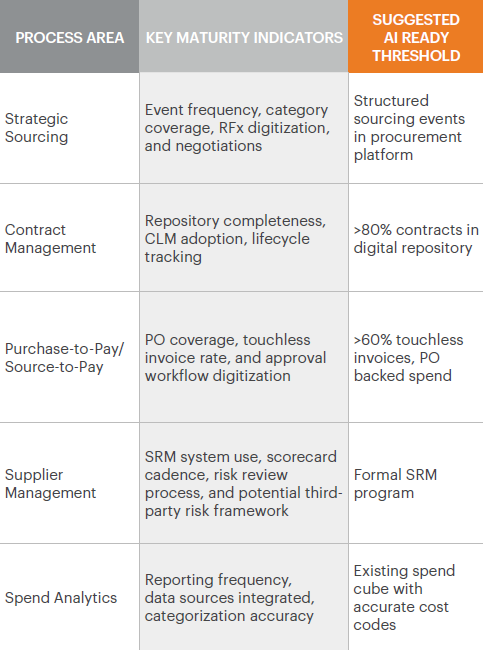
2. PROCESS MATURITY
All dimensions of AI from Predictive through Agentic work best when applied to a well-defined and repeatable process.
3. TECHNOLOGY ARCHITECTURE
AI capabilities in procurement are delivered through three primary architectural patterns. Understanding which applies to your organization shapes the deployment roadmap.
- NATIVE AI IN EXISTING TOOLS: Your ERP or procurement platform has embedded AI features. Lowest integration lift, fastest time to value, but bounded by vendor roadmap.
- POINT AI SOLUTIONS: Specialized AI vendors address specific problems. High capability in their domain, but requires integration and change management.
- ENTERPRISE AI PLATFORM: A horizontal AI platform applied to procurement use cases. Highest flexibility, highest implementation complexity. A custom-built or homegrown LLM can fill this bucket as well.
There is a good chance you are starting from scratch, or that your data foundation is not yet strong enough to support native AI features or a growing stack of point solutions. In many cases, it makes sense to begin with two or three focused use cases and build the capabilities your team needs from there. It is also important to recognize that many AI solutions in the market are powered by similar foundational LLMs. What often differentiates the solutions is not the model alone, but how well they are grounded in your procurement data, embedded into your workflows, connected to your systems, and governed for accuracy, security, and human oversight. In other words, the real advantage comes from how AI is applied in your environment, not just which model sits underneath it.
4. CREATE STRONG GOVERNANCE FRAMEWORKS
Technology without adoption is shelfware. Assess your organization’s readiness to absorb AI-related change.
- AI LITERACY: Do procurement professionals understand what AI can and cannot do? Can they interpret AI outputs critically?
- CHANGE CHAMPIONS: Are there internal advocates who can drive adoption and model new AI ways of working?
- GOVERNANCE: Is there a clear decision framework for when AI outputs require human review versus automated action?
- VENDOR MANAGEMENT CAPABILITY: Can the organization manage AI vendors, evaluate model performance, and enforce contractual data protections?

The Point Solution Conundrum
The procurement technology landscape has evolved rapidly, and AI capabilities are now present across all major procurement functions. This has led to an explosion of tools as well as competing enterprise platforms from major companies like Microsoft and Salesforce. However, enterprise platforms struggle at being perfect for procurement, resulting in the thousands of point solutions that exist for each individual need. Understanding how AI fits within and across these systems is essential for avoiding redundancy, managing integration complexity, and building a coherent AI architecture.
Modern procurement organizations typically operate across five system layers. AI has a tool every layer, but not all AI is equal. Procurement leaders must assess both the maturity of AI features within existing platforms and the gaps that point solutions or custom AI can address.
ERP & FINANCIAL SYSTEMS
ERP systems serve as the system of record for financial data, supplier master, and purchase orders. AI capabilities at this layer are increasingly native:
SAP BUSINESS AI: Embedded AI across key modules such as invoice matching, spend classification, and supplier recommendations.
ORACLE FUSION AI: Predictive analytics for procurement forecasting, anomaly detection in payables, and intelligent approval routing.
WORKDAY ILLUMINATE: Supports supplier contract intelligence, semantic search, metadata extraction, and document-driven workflows that can improve contract visibility and reduce manual effort.
AGENT FRAMEWORKS: Many of these organizations now expose agentic agents that allow downstream AI systems to write back actions with appropriate authorization controls.
PROCURE-TO-PAY (P2P) AND SOURCE-TO-CONTRACT (S2C) PLATFORMS
P2P/S2C platforms such as Coupa, SAP Ariba, Jaggaer, and Ivalua cover strategic sourcing, contract management, and supplier onboarding while also being key transaction systems for handling requisitions, approvals, invoicing, and payments. This is where AI is most rapidly transforming capability.
AI-POWERED RFX:
» Automated requirement drafting, supplier shortlisting, and bid normalization.
CONTRACT AI:
» LLM-powered contract review, obligation extraction, risk scoring, and clause recommendation.
SUPPLIER RISK:
» Integrated risk signals from financial, ESG, and geopolitical data feeds, surfaced at the point of sourcing decisions.
TOUCHLESS INVOICE PROCESSING:
» OCR plus LLM extraction of invoice fields, automated three-way match, exception classification.
SPEND COMPLIANCE:
» Real-time flagging of off- contract or policy- violating purchases at the point of requisition.
INTELLIGENT APPROVALS:
» Dynamic approval routing based on spend category, supplier risk level, and budget availability.
SPEND ANALYTICS & BI
Spend analytics platforms provide the analytical foundation
for AI insights. AI at this layer delivers:
1. AUTONOMOUS CATEGORIZATION:
Models that classify spend to UNSPSC or custom taxonomies with >90% accuracy, continuously learning from corrections.
2. SAVINGS OPPORTUNITY IDENTIFICATION
AI benchmarking, consolidation recommendations, and contract utilization analysis.
3. NATURAL LANGUAGE QUERY
Conversational interfaces that allow non-technical users to query spend data in plain English.
SUPPLIER INTELLIGENCE & RISK PLATFORMS PRIORITIZE EARLY WINS
Dedicated supplier intelligence platforms like Riskmethods and EcoVadis aggregate external data on supplier financial health, supplier performance, and supply chain topology. AI integration at this layer enables:
- Predictive Risk Scoring: AI models that combine financial indicators, news signals, and operational data to predict supplier failure or disruption risk.
- Automated Risk Monitoring: Continuous monitoring with AI alerts and recommended mitigation actions surfaced within procurement workflows.
AI-NATIVE & AGENTIC PLATFORMS
A new category of AI-native procurement platforms like
Zip, Pactum, Archlet, etc. are designed from the ground up
around AI capabilities:
- Autonomous Negotiation: AI agents that conduct supplier negotiations within defined parameters, particularly for tail spend and commodity categories.
- Intake & Orchestration: Conversational AI that handles
procurement requests from internal stakeholders, routes to the correct workflow, and manages the process to completion. - Cross System Agents: AI agents that operate across ERP, CLM, and P2P systems, reading data, synthesizing insights, and executing actions, replacing manual handoffs between systems.

AI FOR PROCUREMENT:
In Action
Procurement is ripe with AI opportunities, yet it is not the first place companies start. The use cases we’ve
high-lighted below are proven, high-ROI opportunities.
CONTRACT INTELLIGENCE
Contracts are the backbone of the supplier relationship, yet most organizations cannot answer basic questions about their own contract portfolio. Organizations have an opportunity to build or buy a contract intelligence solution. The primary challenge is accuracy and trusting the data. Based on our experience, we recommend organizations build a contract intelligence tool that is highly automated, highly accurate, and creates a strong baseline of Metadata.
EXAMPLE CAPABILITIES
- Automated contract ingestion and metadata extraction • Risk scoring and clause
benchmarking • Obligation tracking • Renewal and renegotiation intelligence • Contract deviation detection
INVOICE AND SPEND INTELLIGENCE
Invoice processing remains one of the highest cost, highest friction processes in procurement. AI invoice intelligence eliminates manual data entry, accelerates cycle times, and transforms invoice data into a rich source of spend insight. The agentic opportunity in invoice processing is significant. An AI agent can be configured to approve and release payment for invoices that match within tolerance, are from verified suppliers, and fall within budget or negotiate early payment discounts with suppliers within approved parameters when cash position supports it.
EXAMPLE CAPABILITIES:
- Intelligent document processing • Automated three-way matching • Duplicate and
fraud detection • Spend categorization • Supplier performance signal
POLICY AND PROCESS CHATBOT
Every procurement team spends a disproportionate amount of time answering the same questions: “What is the approval threshold for this purchase?” “Which supplier is preferred for IT hardware?” “How do I submit a sole source justification?” An AI procurement chatbot grounded in your actual documentation eliminates this burden and drives policy compliance simultaneously.
EXAMPLE CAPABILITIES:
- Policy Q&A chatbot • Guided buying • Process navigation • Approval workflow integration • Spend
intelligence for stakeholders
SUPPLIER RISK INTELLIGENCE
Supplier risk has moved from a compliance exercise to a strategic imperative. Geopolitical disruption, climate events, financial instability, and regulatory pressure mean that organizations cannot afford to discover supplier problems reactively. AI transforms supplier risk from a single assessment to continuous, predictive intelligence.
EXAMPLE CAPABILITIES:
- Financial health monitoring • Supplier risk scoring • Supply chain mapping • Geopolitical
exposure • Integrated risk dashboards

AUTONOMOUS STRATEGIC SOURCING
Strategic sourcing has traditionally been constrained by time. The areas of focus have historically only been the largest spend categories, and those categories are routinely reviewed. AI expands the capability, enabling sophisticated sourcing analysis across a far broader range of categories.
EXAMPLE CAPABILITIES:
- Market and benchmarking intelligence • Specification rationalization, substitution, or
standardization • Proposal/bid analysis • Cost modeling • Autonomous tailspend management

Where to Start from Day 1 — or Day 1 Again
The gap between AI leaders and laggards in procurement is widening. Organizations that invested early in data infrastructure
and AI pilots are now deploying full agentic workflows. Those that waited face both a technology challenge and a competitive
disadvantage. Across industries, leading procurement organizations share a consistent set of practices that distinguish them
from peers.

Leaders invested in data infrastructure 12 to 24 months before their AI programs began, including a unified spend cube, a clean supplier master, and a digital contract repository. They did not wait for a specific AI use case to justify data investment—they understood that data quality is the precondition for AI value.

Leading organizations did not attempt to deploy AI across all procurement functions simultaneously. They selected one or two high-value and well-defined use cases to commit to and deploy within their organization. Success will demonstrate the value created from AI.

Leading organizations do not treat AI governance as a compliance burden but rather recognize it as the foundation
of AI adoption. Key governance elements to have in place before broad deployment include: AI policies; Performance
monitoring; Data privacy and vendor risk; Management against AI bias.

Leading organizations are not simply adding AI to existing roles but rather identifying a few redesigned procurement roles to own investment that fits within the procurement operating model around AI.

AI is changing procurement and supplier relationships. Procurement leaders need to intentionally manage how they use AI capabilities with suppliers.
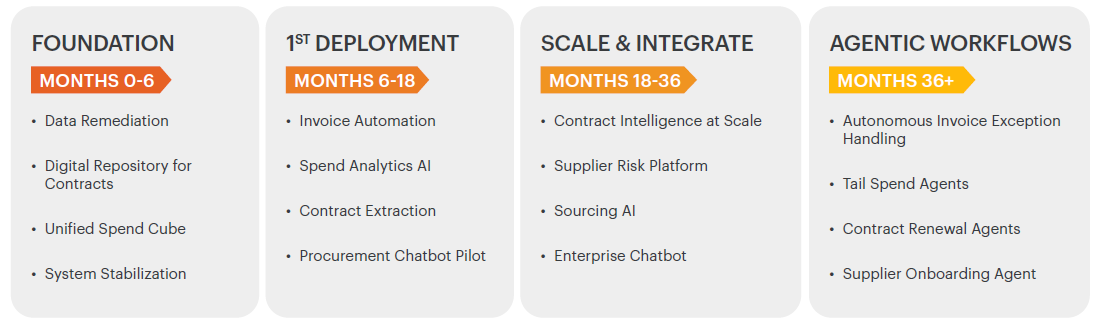
For organizations earlier in the AI journey, the path to leader status follows a consistent progression to set a foundation and prepare the organization for potential agentic solutions:
How a Partner Can Help
AI is different from past digital transformation efforts in that it’s not “just” an innovative technology. Instead, it’s a new kind of tactical capability that’s redefining how work gets done.
Consultants with expertise in AI can help organizations adopt responsible, efficient solutions that move the needle on Day One.
When seeking outside guidance, look for partners who can help:

Choose the right use cases and tailor them to specific improvement opportunities.

Embed AI into existing systems or choose solutions that will not disrupt the business.

Get data AI-ready so AI tools can produce trusted answers.

Set guardrails around security, privacy, data sharing, and other AI risks.

Drive user adoption so multiple teams can benefit.

Operationalize, improve, and sustain an AI program.
Put AArete’s AI Expertise to Work
AArete helps organizations achieve tangible results with practical AI solutions, blending advanced AI tools with human intelligence. Our solutions are formulated to take decisive action in areas like spend management, cost optimization, and operational efficiency, delivering a significant impact on your bottom line. With a combination of leading-edge AI tools and deep expertise, we help procurement teams implement and use AI where it matters most for their organizations.